

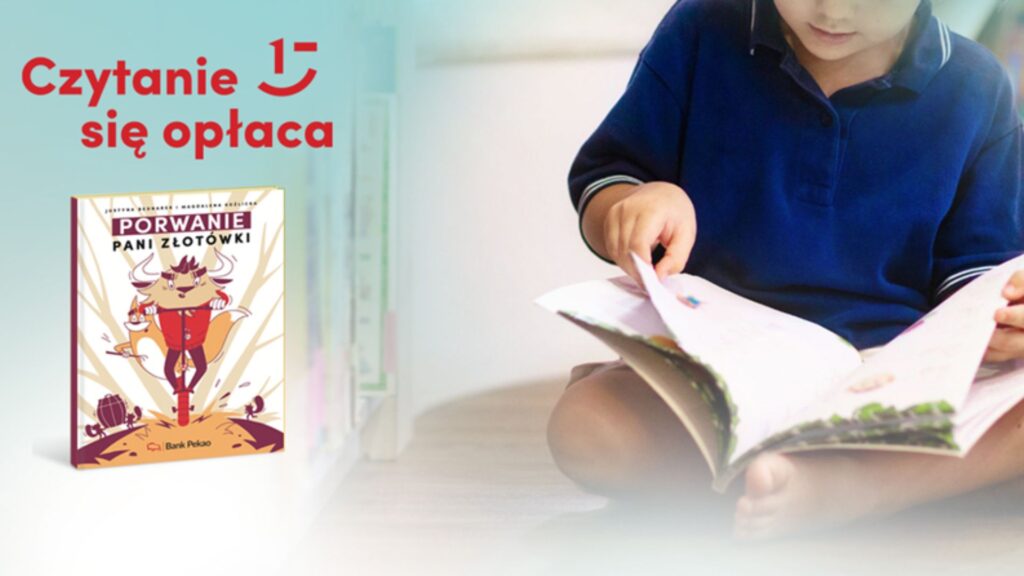
The new school year brings an interesting initiative for first-grade students – the educational campaign "Reading Pays Off", which the Universal Reading Foundation is implementing together with Bank Pekao.
As part of the campaign, a special book for early school children was created: „"The Kidnapping of Mrs. Gold"”, by Justyna Bednarek. This is an educational adventure full of emotions. The book teaches friendship, common sense, and honesty, while also introducing children to the basics of finance, showing them what money is and how saving works.
Title „"The Kidnapping of Mrs. Gold"” It was distributed in printed form to schools that signed up for the campaign, and is also available at selected bank branches. It can also be downloaded as an e-mail. ebook and audiobook, read by Edyta Jungowska, a famous actress and narrator of fairy tales for children from the website: www.ratownicyczytelnictwa.pl/czytasięoplaca
As part of the campaign, in September, teachers of 1,000 first-grade classes across Poland who were the first to fill out the form received packages of books for each student, educational and teaching materials, and gadgets that will facilitate the organization of reading activities in schools in the following months.
Free materials for schools
The initiative aims to encourage students to read for pleasure from the very beginning of their school career. In addition to registered participants, all teachers and students can participate, thanks to free materials available for download online. The ebook, audiobook, lesson plans, posters, and leaflets are completely free. They were created to support teachers and parents in developing children's reading interests.
Caregivers can play an important role – encouraging teachers and schools to use materials and organize activities around reading that will show students that reading has many benefits and that reaching for a book is a real pleasure and good fun.
Why is reading together with your child important and why shouldn't you give up on it too early?
Reading aloud with your child at home is the best way to support their development, but also a reliable method for building a mutual parent-child relationship. This initiative is aimed at first-grade students, who are also beginning to learn to read independently at this stage. It's important to support them in this, while not giving up on reading together. At this age, even children raised with books are often accustomed to quite advanced content. When they begin reading on their own, books that align with their interests can be too demanding. Therefore, it's important not to give up on shared reading, building and nurturing reading habits, and, in the process, fostering memories of closeness between parents and caregivers.
How reading shapes a child's competences and influences their future
Reading is the foundation of education, not just in the humanities but in all fields. It increases students' opportunities in all fields, including science. Reading supports the development of future skills, helping them understand new technologies and use them safely.
Reading for pleasure is crucial to children's development, and reading together and discussing books builds relationships with their parents. It's the best way to spend time and support children's interests. Being a role model for reading is incredibly important. It's worth nurturing reading skills at home and supporting teachers who work with them at school in building daily reading habits! Reading in the classroom, visiting libraries, building school libraries, supporting reading events and activities around books are all important activities that bring results. Access to books is also important in homes – both in terms of the presence of books and a space for reading.
People raised in homes with books who did not complete their studies have higher reading, mathematical, and technological competences as adults than university graduates who grew up in homes without books.
*Joanna Sikora, MDREvans, Jonathan Kelley, Scholarly Culture: How Books in Adolescence Enhance Adult Literacand
How reading shapes a child's competences and influences their future
We know that reading supports development, expands vocabulary, and books are a source of knowledge, but there's more. Research shows that reading builds children's opportunities in many ways!
Here are some areas that reading specifically supports:
- Financial education and economic awareness – The "Reading Pays Off" campaign also includes financial education support. Children learn basic concepts such as money, saving, and the value of things, which helps them better understand financial matters in the future.
- Success in science and life Children with a good start in reading achieve better results in school; reading comprehension supports learning in all subjects, not just Polish. Research shows that children raised in homes with many books have greater educational opportunities.
- Safe use of technology – Analytical thinking skills support resilience to disinformation and the challenges of new technologies. This is especially important in the age of digitalization, including the development of artificial intelligence.,
Bank Pekao SA cares about the financial education of the youngest
We know that reading develops a range of skills, including financial ones. It's worth appreciating the fact that institutions like Bank Pekao SA are taking a broader, long-term approach to financial education. That's why, in June of this year, the "Child's Financial World" report was published in conjunction with the research institution IQS. It shows that children are beginning to interact with money at an increasingly earlier age. As many as 95% of children aged 9-13 receive pocket money – through experience with their own money, children learn to manage their budgets. This is crucial for their independence and responsibility in adulthood. The world of finances can be complex, so it's worth showing children from an early age how to approach money wisely.
The PeoPay KIDS banking app, designed specifically for children and celebrating its fifth launch this year, also introduces financial education in a fun way. It aims to facilitate their first experiences with money and teach them how to manage their funds consciously.
These activities, along with Bank Pekao's pro-reading and educational campaign with the Universal Reading Foundation, demonstrate that combining reading and financial education is an investment that pays off throughout life, shaping a responsible and informed generation. It's important to implement these tasks at school and at home.